

A road trip to financial freedom
Untangle the knotted web of investment terms
By Lizelle Steyn
Updated 13 October 2026
As someone who gets excited about other people’s journeys to financial freedom, I love to ask what they’re invested in. But few people can speak confidently about their portfolios and investment choices. Many know which investment platform they're on, as that's the entity that corresponds with them, but they might not know which funds they're invested in, or that they're under no obligation to invest in the funds of a company like Allan Gray or Sygnia when using their platform. And sometimes it's even possible to bypass an investment platform altogether, if it doesn't add value to your life.
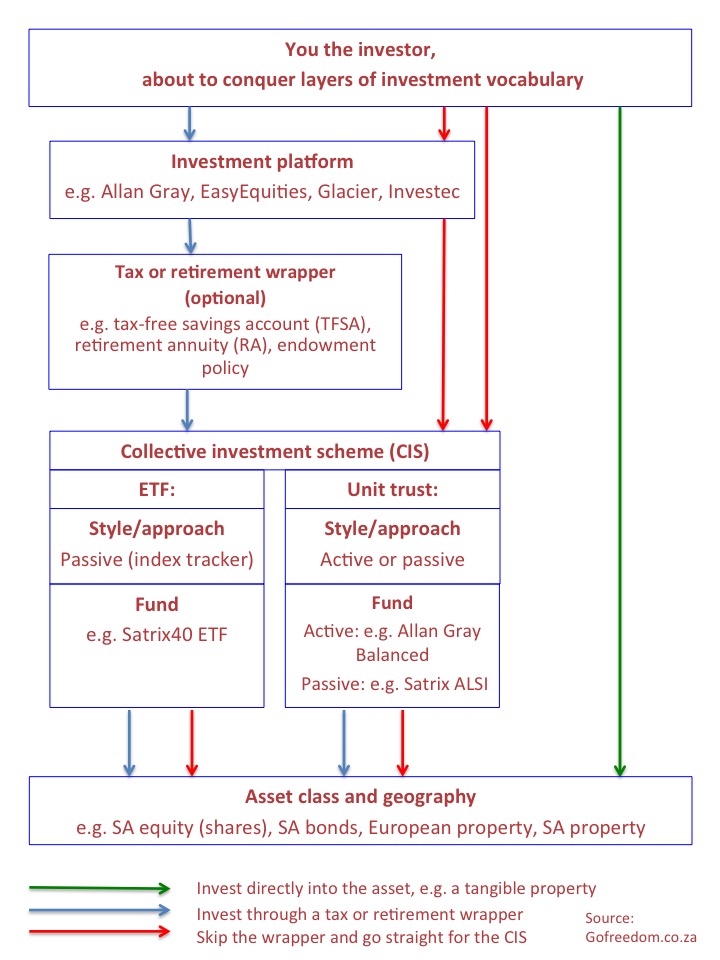
As we dig deeper to find out what exactly they’re invested in, it gets messy trying to untangle this web of terms that our industry uses. Is it possible to capture all the layers investors’ money have to move through to finally end up in a basket of shares? A picture might help.
Bypassing the financial industry is easy – if you have deep pockets and don't mind these risks
There is a way to bypass the financial services industry completely, never needing to speak this language. Simply buy an asset, such as a house or apartment or a bar of gold directly. It’s the green route above. You’ll save yourself the headache of having to learn a whole new vocabulary of investment terms. But there are also plenty of cons to following the green route, of which I list only a few:
- you can’t invest small amounts, such as R200 per month. You’ll need access to larger amounts of capital
- You’re not building a diversified portfolio. Even if you buy 10 houses, you’re still 100% exposed to the South African property market and the local economy and interest rates. Great if we’re in a property boom cycle; not so great otherwise, as is the nature of concentration risk.
- You might not be able to sell your asset quickly (liquidity risk).
- You’re potentially missing out on awesome tax breaks.
Using the financial services industry for your financial freedom journey definitely has benefits. The first one is tax.
Using a tax wrapper could – legally - fast forward your financial freedom plan
The first thing you need to look at if you’re ready to boldly step into the world of investments, is a tax-efficient way of investing. There are several 'wrappers' - legal structures that change the nature of your investment so that you'll be subject to different tax and other laws if your investment is wrapped within them. In our diagram above, that would mean following the blue route. A general rule is that everybody should have an investment wrapped in a tax-free savings account (TFSA). You will pay no tax on a TFSA at any stage of the game, except for the 40% penalty from SARS if you invest more than the current R46 000 annual contribution limit. So, monitor your contributions carefully. If you’re investing for the long term, make your TFSA contributions your investment priority, assuming you already have a separate emergency fund.
Then, if you're able to invest more than R46 000 per tax year and have already contributed to your TFSA in full, you might want to look at reducing your annual tax bill further by also investing in another common tax wrapper - a retirement annuity (RA). Just remember that with an RA, yes, you can now withdraw small amounts per year until retirement, but you can’t touch the rest of your RA money until age 55. An RA is about deferred tax, and particularly makes sense if you estimate that you'll be in a lower tax bracket in retirement. Even if you won't be in a lower bracket, for all those years before you retire, your money is growing tax-free.
Make sure to choose an RA with no hidden commission, complicated bonus systems or penalties. You should be able to add money as and when you want. And stop contributing at any time – penalty free.
An investment platform is the face of your investment
Popular investment platforms include Allan Gray, Easy Equities, Glacier, NinetyOne, Stanlib and Sygnia. They are the companies with whom you’ll interact along your investment journey - via call centres, instant messaging, apps, web login and email. They'll determine your client experience, so choose wisely. They’ll do a valuation of your investments daily so you can keep track of how it's growing, and they'll send you regular statements and your annual tax certificates.
Some have more tax wrappers than others, e.g Allan Gray has a preservation fund, an RA, a TFSA and an endowment policy, while others might not yet have a preservation fund or endowment policy. For a TFSA you don't need to work through a platform. But if you need a retirement wrapper, you would normally need an investment platform (with exceptions like an RA from Nedgroup).
By definition, investment platforms offer collective investment schemes from many different investment companies conveniently in one "shop". So, if you want to diversify your portfolio and invest in funds from a variety of different investment companies / fund managers and view them all on one dashboard, you would also need to go through an investment platform.
When the platform is optional
To summarise the route choices, if you need a retirement product, you’ll be following the blue route of the diagram, normally starting at the investment platform. If not, follow any of the red routes. You can either use the platform for convenience, or go straight to a company offering collective investment schemes with the underlying funds that you’re interested in. For example, say you've decided that you want to invest in the Coronation Balanced Fund, the Nedgroup Investments Core Diversified Fund and one of the popular Satrix funds. You could either use a platform like Allan Gray or Sygnia offering all these funds, and only interact with Allan Gray or Sygnia to get your investment values for and transact on all these funds. Or skip a platform and go directly to each of Coronation, Nedgroup and Satrix separately to buy their respective funds and get updates and tax certificates from each company separately. It’s more admin and time intensive, but will save you the small annual platform fee.
What are collective investment schemes, and are they the same as unit trusts?
‘Collective investment scheme’ is the umbrella term for all sorts of funds in which retail investors can pool small or large investment amounts together with other investors wanting to invest in the same type of underlying assets, like the stock market or property. A collective investment can be an:
- exchange traded fund (ETF)
- unit trust
- real estate investment trust (REIT)
- retail hedge fund
ETFs and unit trusts are the most common. A CIS is an almost invisible legal structure that’s needed to invest in a Satrix or Allan Gray or Sygnia fund, for example.
For all practical purposes, to simplify the mental model: Fund = collective investement scheme = either ETF or unit trust.
ETF or unit trust?
Unit trusts used to be actively managed and ETFs passive (tracking the performance of a published index, like the JSE All Share). Index-tracking is a way to lower fees in your portfolio but most index (passive) funds don't buffer you against market crashes like some active managers try to do. And, by definition, you won't outperform the index. Nowadays there are plenty of passive unit trusts and the number of actively managed ETFs are also growing, so the line between ETF and unit trust is blurring.
Some platforms, like Sygnia, offer unit trusts and ETFs. Other platforms, like Allan Gray, offer only unit trusts (which include index tracking/passive funds). Sygnia and Allan Gray play two roles: they perform both the role of platform and the role of fund manager of their own branded funds.
Asset class and geography
And after this labyrinth walk of complex decisions, your money finally ends up in the most important place of all – the underlying assets which the fund manager of your chosen fund/s buy on your behalf. But you decide on the types of assets (asset classes) through choosing either an equity fund or a property fund or a money market fund or a balanced fund (blend of assets). The four traditional asset classes are equity, bonds, property and cash. Asset allocation is your most important decision. On average, equity (shares) outperform cash by more than 4% per year over the long term. Choosing equity (shares) instead of cash as an asset class could be the difference between tripling and doubling your investment over 12-15 years.
But shares make for a rocky ride, be warned. It’s worth looking at this No risk, no reward infographic that I did for my previous employer – with the help of our talented graphic designer - to get a better idea of the importance of choosing the right asset class with the right amount of risk. In my case, because I have a moderate and not an aggressive risk profile (i.e. I will take on risk, but don’t stomach dramatic downs in my portfolio well), I prefer a blend of asset classes, even though equity has proven best over the long term, so I can have a smoother investment experience. And I also include offshore assets, not only SA. Currently 70% of my total portfolio is exposed to the equity asset class; the remaining 30% is exposed to bonds, cash and property. And geographically, 50% is offshore, 50% in SA.
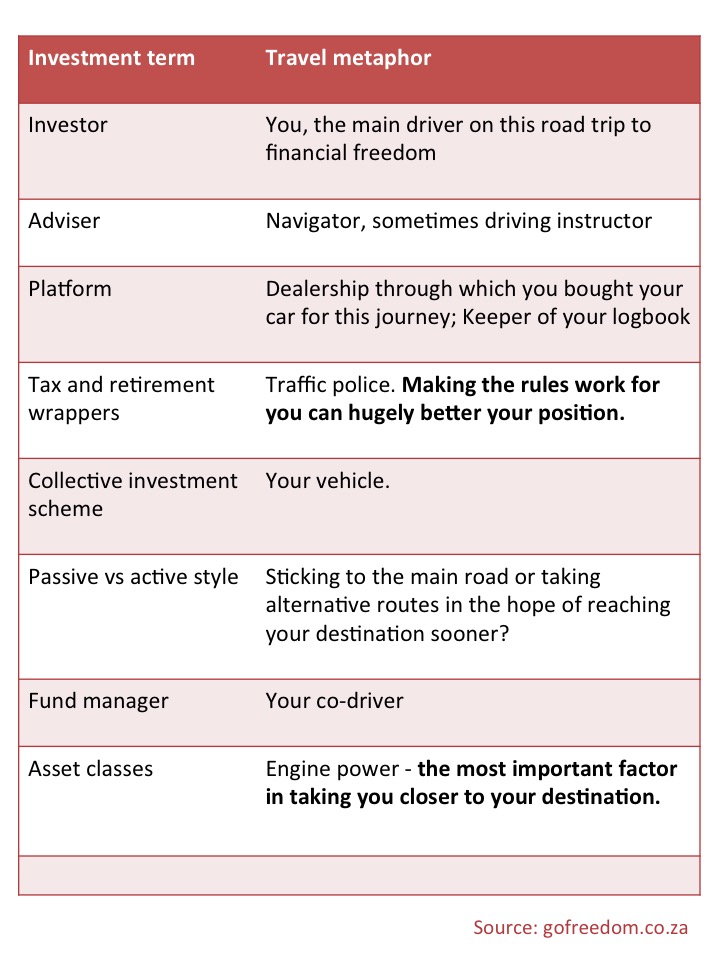
If your investments were a car…
Now it’s over to you. As with learning any new language, don’t be afraid if it comes out all wrong at first. Keep on asking questions, and keep on practising with your adviser or friends and family who are also showing an active interest in the world of wealth building. Soon you’ll be speaking investments like a pro.