
A road trip to financial freedom
Tax-free savings account or retirement annuity?

Photo credit: Leah Kelly
By Lizelle Steyn
Updated 27 October 2026
A tax-free savings account (TFSA) and a retirement annuity (RA) are the two most important tools when saving for retirement and for long-term wealth creation. If you're following my 9-step plan to financial freedom it's time to start exploring these two options as soon as your debt is settled and an emergency fund is in place. A tax-free savings account and a retirement annuity are also the two most popular ‘tax wrappers’ in South Africa.
What is a 'tax wrapper'?
A ‘tax wrapper’ wraps your exchange traded fund (ETF) or unit trust in a legal entity that protects it against the tax that you would normally have paid without this wrapper - for as long as you remain invested in these two structures. Tax wrappers are a great way to pay significantly less tax and this diagram on important investment tools like a tax-free account, retirement annuity, ETF and unit trust, may help to visualise how they fit together.
Tax-free savings account or retirement annuity?
A tax-free savings account and retirement annuity make a good team, helping you on your financial journey, but if you need to decide which one to prioritise at first, for most investors the short answer would be: Tax-free savings account.
A TFSA has no disadvantages, except that you're allowed to invest only R46,000 in the current tax year before the 40% tax penalty kicks in. More about TFSAs in a previous blog post on how to choose the best tax-free account.
When you are closer to the end of your career and in the higher tax brackets, it's worth asking a financial adviser to estimate and compare the future benefits of each, using a set of earnings and future tax assumptions that's realistic and refined for your unique circumstances. Adrian Hope-Bailey from Fynbos Money has coined the term Rule of 45 after running a few scenarios and finding that prioritising an RA becomes more attractive for older investors in the 45% tax bracket. Just remember that the tax saved by contributing to an RA now is partly offset by the fact that your income resulting from this retirement product will be taxed in retirement. The withdrawals from a TFSA will not. Every part of it at every stage is tax-free.
When is a retirement annuity necessary alongside a tax-free account?
- When you have more than the current annual TFSA limit of R46 000 to invest, let the rest spill over into a retirement annuity.
- When you know that you can and have been impulsive with some big expenses in the past, then the restrictions of a retirement annuity can be a mechanism to protect yourself from withdrawing your long-term savings
- When you want to protect yourself against creditors (a retirement product can only be accessed by SARS or your ex-spouse when included in a divorce order)
- When you want to protect your heirs against paying estate duty (an RA falls entirely outside of your estate)
RA and TFSA comparison
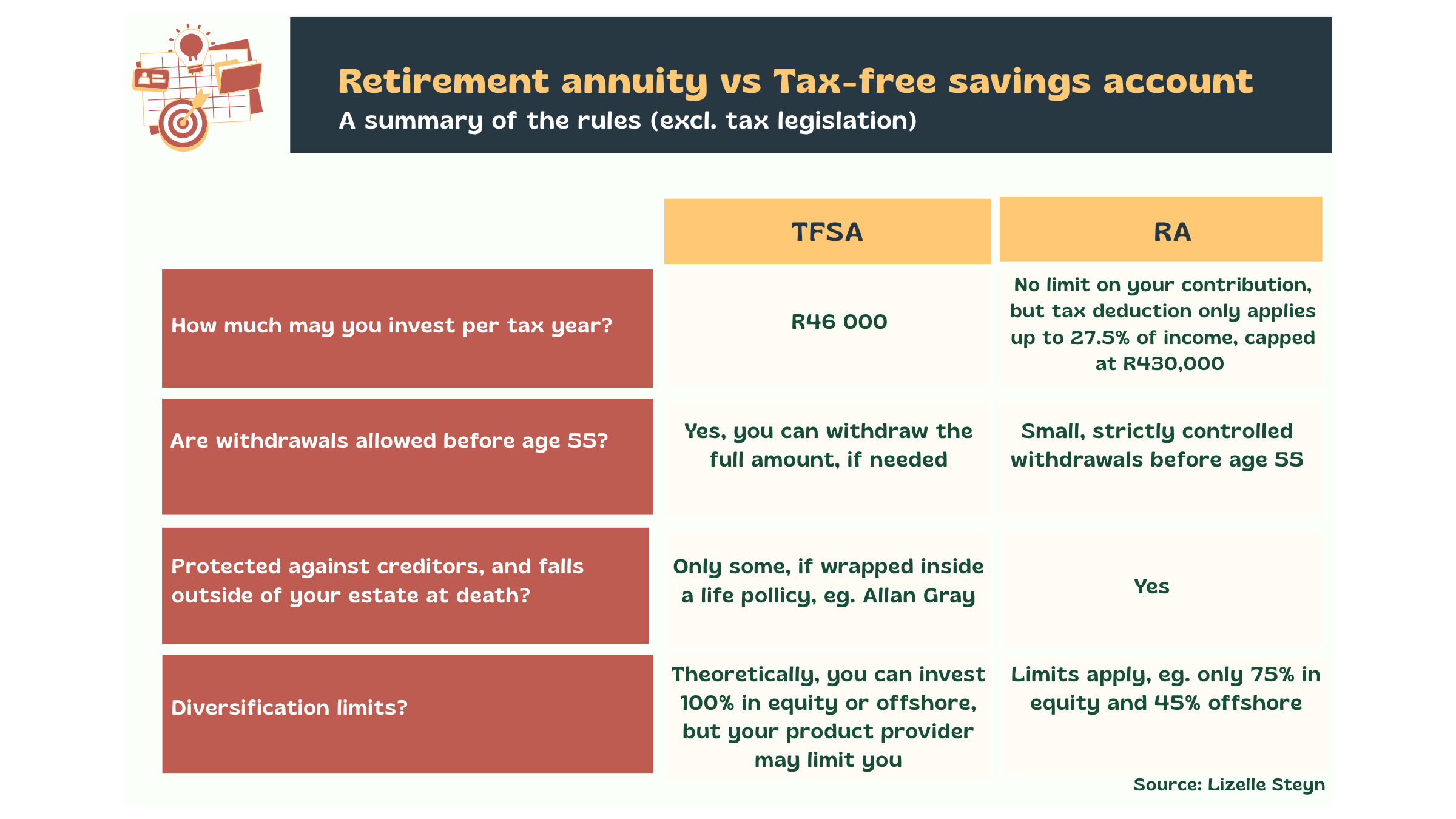
The tax on a TFSA vs an RA: in a nutshell
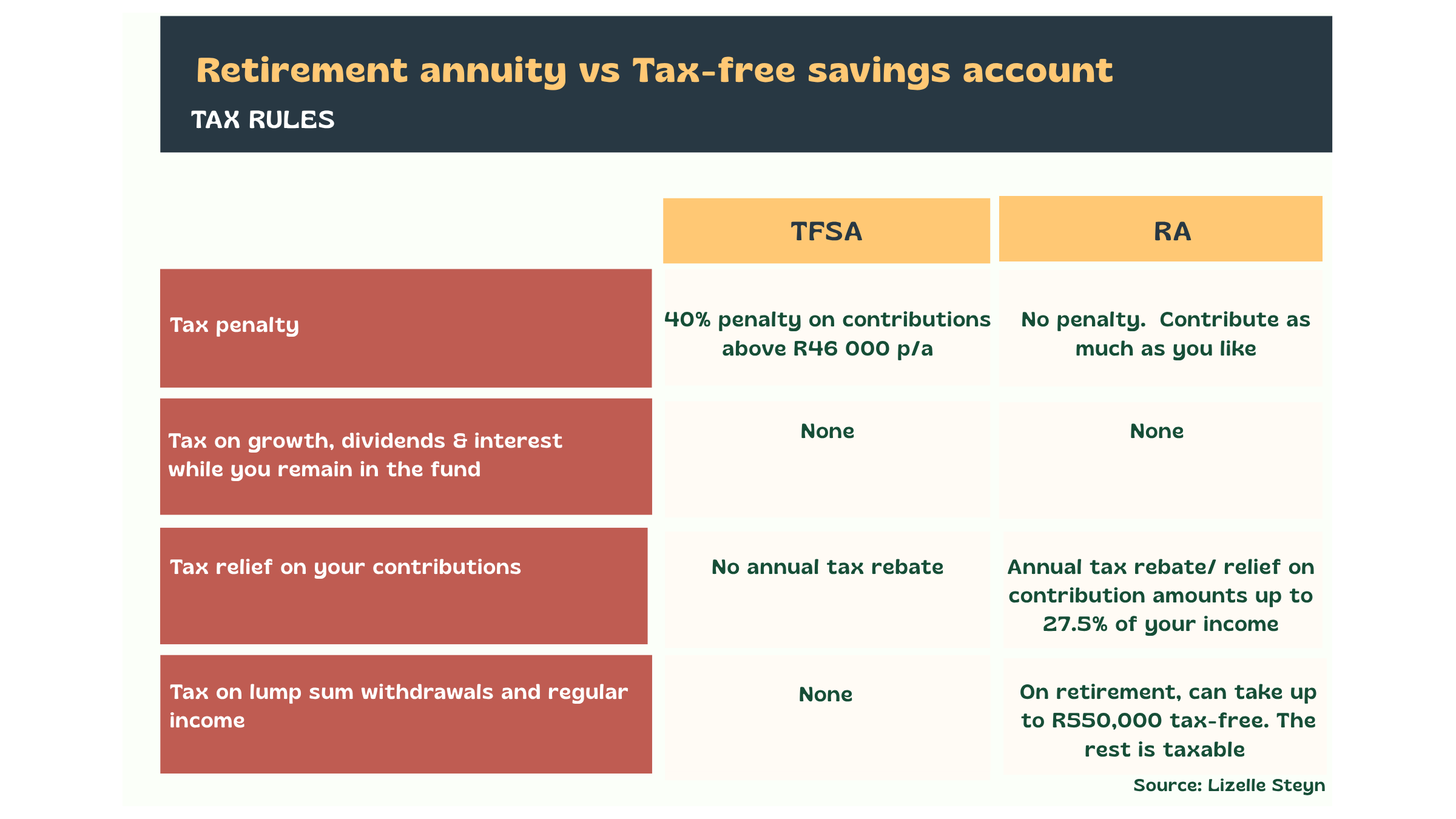
If you want to dig into more detail, have a look at this RA and TFSA comparison that I did for my previous employer. Bear in mind that since then the annual contribution limit for a TFSA has been increased to R46,000 per tax year (used to be R36,000). On the RA side, it's now possible to contribute up to R430,000 per tax year and enjoy a tax rebate (used to be R350 000). And when you retire, up to R550,000 (used to be R500,000) can be taken in cash at a 0% tax rate. Also, the new two-pot system allows some withdrawals from your RA every year. However, the tax on these withdrawals can be punitive; best to think of an RA as money you can't touch before age 55.